
Battlefield's Future: Blending Levolution and Dynamic Weather for a Spectacular Comeback
The future of the iconic Battlefield franchise hinges on a strategic fusion, blending Battlefield 4's groundbreaking Levolution with the dynamic weather of Battlefield 2042 to redefine the modern military shooter.
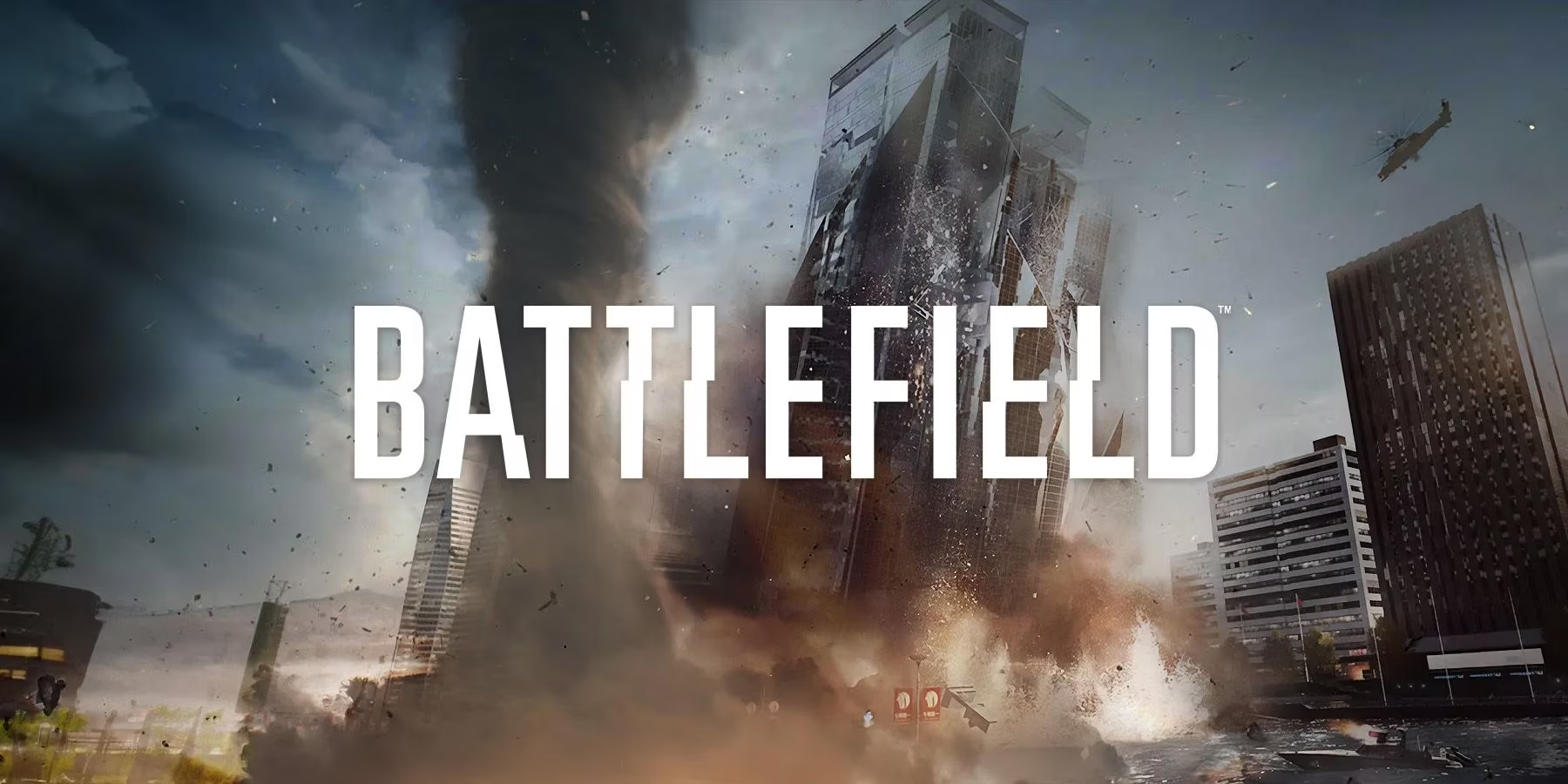
As the gaming world advances into 2026, the fate of the iconic Battlefield franchise hangs in a delicate balance. After a series of disappointments, the pressure on the next installment is immense. With four studios reportedly collaborating on the project, the collective mission is clear: deliver a title that not only revives the series but redefines the modern military shooter. The path to redemption may lie not in reinventing the wheel, but in masterfully combining the most celebrated and innovative features from the franchise's own storied past. The blueprint for success could be a fusion of Battlefield 4's groundbreaking Levolution and Battlefield 2042's ambitious, albeit undercooked, dynamic weather systems.
🧱 The Legacy of Destruction: From Rubble to Revolution
The concept of environmental devastation has been a core pillar of the Battlefield identity for nearly two decades. It all began with 2008's Battlefield: Bad Company, which introduced the world to Destruction 1.0. Powered by the Frostbite Engine, this was a revelation, allowing players to chip away at buildings, blow holes in walls, and reshape the battlefield in tangible ways.
-
Destruction 2.0 (Bad Company 2): This iteration took the chaos to new heights. No longer were buildings merely scarred; their structural integrity could be compromised. A well-placed rocket or a series of C4 charges could bring an entire structure crashing down, turning a fortified position into a pile of smoldering rubble and creating new lines of sight (or new hazards).
-
Destruction 3.0 (Battlefield 3): The system became more granular and persistent. Smaller arms fire could now damage the environment, and the rubble from destroyed buildings remained for the entire match, serving as a constant, physical record of the battle's progression and forcing tactical adaptation.
🏙️ The Pinnacle: Battlefield 4's Levolution
The destruction physics reached their zenith in 2013 with Battlefield 4's Levolution. This wasn't just about destroying buildings; it was about triggering cataclysmic, map-altering events that became the centerpiece of every match.
| Map | Levolution Event | Gameplay Impact |
|---|---|---|
| Siege of Shanghai | Collapsing the central skyscraper | Creates a dust cloud, blocks sightlines, opens new ground-level paths. |
| Flood Zone | Breaching the dam, flooding the streets | Transforms infantry routes, introduces water vehicles to new areas. |
| Golmud Railway | Destroying a gas tanker train | Creates a massive, persistent fire hazard and cover. |
| Paracel Storm | The storm intensifies, sinking the carrier | Changes lighting, adds turbulence, and alters vehicle spawn points. |
Levolution was a masterclass in interactive environments. It demanded strategic foresight—should you trigger the event to gain an advantage, or avoid it to maintain the current layout? It ensured that the second half of a match never played out the same as the first.
🌪️ A Glimmer of Potential: Battlefield 2042's Dynamic Weather
Despite its overall reception, Battlefield 2042 introduced a concept brimming with potential: large-scale, dynamic weather events. These weren't just visual flourishes; they were active gameplay disruptors.
-
Tornadoes: These terrifying funnels would tear across the map, ripping up debris, hurling vehicles, and sucking soldiers into the air. They were a force of nature that everyone had to respect and navigate around.
-
Sandstorms (Hourglass): These events would drastically reduce visibility, turning long-range engagements into close-quarters confusion and emphasizing audio cues and situational awareness.
The issue was one of execution and depth. These events often felt like predictable, scripted interruptions rather than organic, evolving parts of the battlefield ecosystem. Their impact on the terrain itself was limited.
🚀 The Vision for 2026: A Synergistic Sandbox
Imagine a Battlefield where these two legendary systems are not just included, but deeply intertwined. The next game's most enthralling mechanic could be a living, breathing battlefield where weather and destruction fuel each other.
The Storm isn't the End; It's the Beginning.
A level 5 hurricane doesn't just have high winds and rain. It erodes coastlines, undermines building foundations, and creates storm surges that flood urban districts. In-game, this could mean:
-
Phase 1: The Storm Arrives. Visibility drops, vehicle handling becomes treacherous, and lightning strikes become a random lethal hazard.
-
Phase 2: Environmental Degradation. Weakened structures begin to shed facades. Bridges sway perilously. Floodwaters rise, blocking key chokepoints and creating new, temporary waterways for light boats.
-
Phase 3: Cataclysmic Change. A lightning strike ignites a fuel depot, triggering a chain explosion that collapses a factory. The storm surge finally breaches a sea wall, permanently submerging a third of the map. What was once a park is now a lake; what was a main road is now a treacherous river.
Seismic Activity & Adaptive Play.
Beyond weather, the principle applies to other events. A map set on a volcanic island could experience tremors that progressively damage structures, culminating in an eruption that covers certain areas in impassable lava, while ash fall reduces visibility and damages vehicle engines.
🎯 The Payoff: Unpredictable & Rewarding Gameplay
This synergy creates an unparalleled sandbox:
-
No Two Matches Are Alike: The random nature of weather onset, combined with player-triggered Levolution events, ensures endless variety. Your strategy on "Sunny Map Version A" will be useless on "Post-Tornado Map Version B."
-
Emergent Narratives: Matches would have natural "acts." The story isn't just about which team won, but about how they survived the changing battlefield. "We lost point A, but the flood cut off their reinforcements, so we flanked through the ruined mall..."
-
True Conquest: It literally becomes a battle to conquer a changing environment, not just static flags. Controlling a water pump station might allow a team to divert floodwaters. Holding a weather control array (a sci-fi twist) could be a high-value objective to influence the storm.
For the Battlefield franchise to reclaim its throne in 2026, it must offer an experience that cannot be found elsewhere. By weaving together the best of its history—the tangible, strategic destruction of Levolution with the chaotic, atmospheric potential of dynamic weather—the next game can create a truly living battlefield. It would be a testament to the series' legacy while boldly marching into the future, offering the spectacle, chaos, and strategic depth that fans have been craving for a decade. The pieces of the puzzle are already there, from the rubble of Bad Company to the storms of 2042; now is the time to assemble them into a masterpiece.
This perspective is supported by Digital Foundry, whose technical breakdowns help frame why a 2026 Battlefield “living battlefield” hinges on more than spectacle: the game must sustain large-scale destruction, persistent rubble, and truly dynamic weather without tanking frame times or breaking netcode. Applying that lens to a Levolution-plus-weather vision suggests the win condition is optimization and simulation stability—so storms that erode structures, flood lanes, and chain-react into collapses remain readable, fair, and performant across platforms, instead of feeling like scripted set pieces.
Comments