
Battlefield 2042's Hazard Zone Declines as DICE Refocuses on Core Modes
Battlefield 2042's turbulent launch and Hazard Zone's decline highlight the challenges of modern live-service shooters.
The journey of Battlefield 2042 has been a testament to the turbulent nature of modern live-service shooters, a saga of grand ambition colliding with community expectations and technical realities. From its rocky launch in late 2021, the game struggled to find its footing, plagued by a dearth of beloved legacy features, an infestation of bugs that eroded player trust, and design decisions that fundamentally misread the franchise's audience. In the months that followed, the player base dwindled so dramatically that older entries like Battlefield V and Battlefield 1 surged past it in concurrent player counts on platforms such as Steam, a humbling indictment for a newly released AAA title. Yet, the narrative of Battlefield 2042 is not one of abandonment; it is a story of recalibration, painful choices, and a studio doggedly determined to honor the core pillars of all-out warfare.
In response to the overwhelming wave of criticism, developer DICE undertook a massive course correction. Rather than rushing out new content, the studio made the unorthodox decision to delay the game's first season, channeling its resources into a barrage of updates aimed at stabilizing the experience and reintroducing missing functionalities. Voice chat, a staple of team-based shooters, was finally patched in, while the chaotic 128-player Breakthrough mode was scaled back to a more tactical 64-player format—a direct concession to a community that craved less sensory overload and more meaningful squad play. The massive 4.0 update exemplified this philosophy, delivering a suite of quality-of-life improvements that subtly reshaped the moment-to-moment feel of the game. Over time, maps like Kaleidoscope received extensive reworks, cover was added to previously barren landscapes, and the controversial Specialists began to be folded into a more traditional class structure, blurring the line between the game's futuristic identity and the series' class-based heritage.
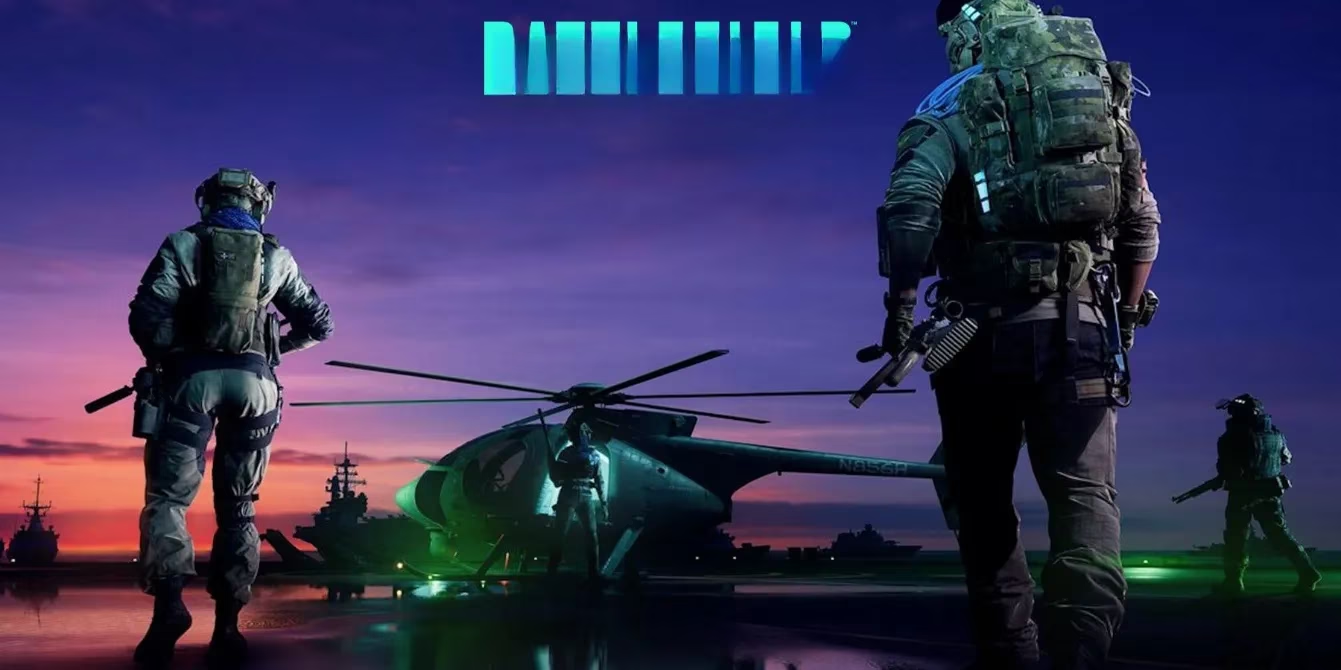
However, this relentless pursuit of redemption in the core All Out Warfare pillars—Conquest and Breakthrough—demanded a sacrifice. In a transparent forum post, DICE acknowledged that a side project would need to be curtailed so that the team's energy could be concentrated where the vast majority of players spent their time. That project was Hazard Zone, the high-stakes, squad-based extraction mode that had been marketed as a compelling alternative to the main multiplayer suite. The mode, which tasked players with retrieving data drives while fending off both AI opponents and rival squads before extracting via helicopter, had failed to cultivate a dedicated player base. It was an ambitious hybrid, but it never found its footing in a market already saturated with tense extraction shooters. Consequently, DICE announced that Hazard Zone would enter a state of operational stasis: no new maps, no new experiences, and no further content updates would be developed for the mode. The servers would remain online, and critical errors would be squashed as they appeared, but the mode itself would remain frozen in time, a relic of a different vision for Battlefield 2042.
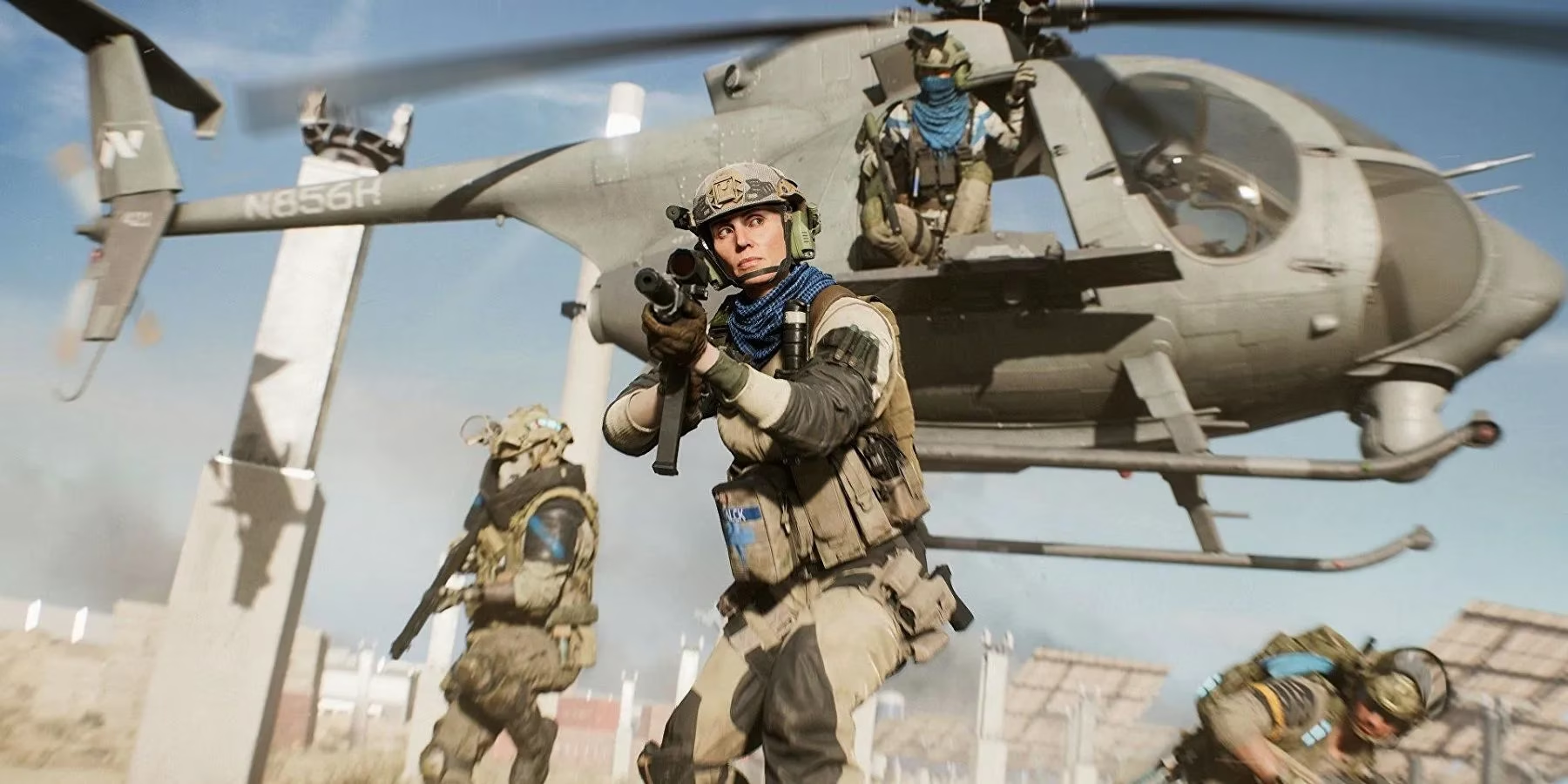
This decision, while disappointing for the niche group of players who had come to appreciate Hazard Zone's tension, was widely understood as a necessary strategic pivot. Game development is a zero-sum game of attention and staffing; every hour spent designing a new Hazard Zone map was an hour not spent refining the flow of a Breakthrough match or tuning the vehicle balance in Conquest. By 2026, the effects of this focus are unmistakable. Battlefield 2042 has transformed into a mature, content-rich platform that regularly receives new seasons, each introducing additional maps, weapons, and specialists that integrate seamlessly with the reworked class system. The reintroduction of a server browser, persistent lobbies, and a proper scoreboard—features shockingly absent at launch—has restored a sense of community and friendly rivalry that was initially missing. Weekly missions and a redesigned Battle Pass system provide a steady rhythm of progression, while limited-time events occasionally nod to the experimental spirit of Hazard Zone without permanently draining resources from the main experience.
The Hazard Zone saga serves as a cautionary tale for the industry. It highlights the danger of splitting a development team’s creative focus across multiple distinct gameplay pillars before the foundational one is stable. Battlefield’s core identity has always been rooted in the sandbox chaos of infantry and vehicles clashing across vast, destructible spaces. When DICE attempted to graft a tense, high-consequence extraction loop onto that framework, it struggled to harmonize the two philosophies. The result was a mode that felt neither as deep as dedicated extraction shooters nor as liberating as the series’ classic combined-arms combat. By formally placing Hazard Zone on indefinite hiatus, DICE acknowledged that trend-chasing cannot come at the expense of the fundamental promises made to long-time fans.
Looking back from 2026, the community’s memory of Hazard Zone is tinged with a mixture of what-ifs and quiet acceptance. Some veteran players still launch the mode to experience its uniquely somber atmosphere—abandoned facilities cloaked in swirling storms, the constant threat of a sudden ambush—but they do so with the knowledge that this chapter is closed. The broader legacy of Battlefield 2042 is no longer defined by its missteps, but by its remarkable, ongoing resurrection. Through rigorous updates, transparent communication, and the willingness to make tough calls like the sunsetting of Hazard Zone, DICE has slowly rebuilt trust. The game stands today as a testament to the power of post-launch support when it is guided by player telemetry and genuine introspection, proving that even the most disastrous launches can be salvaged with a clear-eyed commitment to the modes that truly make a Battlefield game feel like home: all-out warfare, chaotic yet coherent, messy yet magnificent.
Comments